Bicester u3a operates as an independent, unincorporated charity, regulated by the UK Charity Commission. It currently (September 2026) has a membership of around 380. There are monthly talks, excursions, a Christmas lunch, an annual holiday, and some 57 assorted interest/activity groups where people can share their hobbies and their pastimes. Generally speaking, members come from Bicester and the surrounding villages. The 40th anniversary of the formation of Bicester u3a seems to be an opportune moment to look back at the way in which the organisation began, and how it has evolved.
The University of the Third Age (the UK organisation changed its name to u3a in 2020) is a movement that provides opportunities to keep active, meet people and explore shared interests in a relaxed, friendly environment. With a vast number of Special Interest Groups ranging from art, languages, history and games, to science, music and exercise, there are plenty of chances to socialise, keep learning and have fun with others.
History of U3A
Origins in France
The idea that became the U3A began in France during 1972, at a summer school for older adults. In 1973, Professor Pierre Vellas launched the first formal third-age program at the Faculty of Social Sciences, University of Toulouse as an extramural university activity.
The so-called 'Third Age' of life is a sociological concept; one of four distinct periods into which the human life-course is split by some sociologists. It is an abstract idea used to describe, analyse, and understand patterns of human social behaviour. According to this model, the ‘Third Age’ is a time of active retirement, characterized by good health, personal growth, and leisure: an opportunity to undertake learning for its own sake. There is no minimum age, but the focus is generally on people who are no longer in full-time employment, or raising a family. Upon entering the ‘Third-Age’, it is believed that regular physical and mental activity helps to maintain independence, strengthen bones and muscles, and support brain health.
In France, each University of the Third Age University group is mostly associated with a local university. This academic model is used in many other countries, in particular in continental Europe. The university affiliation generates various opportunities such as access to highly qualified teaching personnel, a variety of subject choices, possibilities for students and faculty to conduct research based on the professional, cultural or historical experiences of the elderly, etc. The U3As do not issue diplomas but rather certificates and teach in many fields according to the particular interests of the groups of older students (usually aged 55+). Subjects often include, computer skills, languages, entrepreneurship, theology, politics, etc. Some U3As provide groups with chances for vocational training and formal continuing education.
In the 1990s the concept was broadened in France to become the University of All Ages (Université tous âges), and currently exists using a number of names: Universities of the Third Age (UTL), (Université du Temps Libre); Universities for all ages (UTA); intergenerational Universities (UIA); or Universities for everyone (UPT). They are local, or regional, cultural associations whose members have free time and wish to expand their knowledge, share their expertise, participate in workshops, and meet people from diverse backgrounds. While they do not award degrees, it is recognised that UTLs play an important social role: making culture and new knowledge accessible and understandable to all, within an open and welcoming environment.
AIUTA (Association Internationale des Universités du Troisième Âge) is the global international organization and network of Universities of the Third Age, including such institutions from most continental European countries, Central and East Europe, China, Russia, Latin America, etc., including Mauritius and other places.
Reshaped in the UK
In 1982, the University of the Third Age movement was radically reshaped in the UK by Peter Laslett, Michael Young, and Eric Midwinter, who took the view that most people of retirement age have something to contribute, and the emphasis is on sharing, and learning without formal educational links. The focus is on self-help, with no formal qualifications. In this way, the UK model differs significantly from the French concept.
Whereas:
The French Model is University-Linked:
- Affiliation: Strongly tied to traditional, local higher education institutions (such as universités tous âges or universités du temps libre).
- Teaching Style: Relies heavily on professional academics, university lecturers, and paid experts delivering formal lectures.
- Setup: Operates top-down using actual university facilities and lecture halls.
The British Model is based on Self-Help and is Peer-Led:
- Affiliation: Completely independent of traditional universities. Managed as local charities coordinated nationally by the Third Age Trust. [1, 2]
- Teaching Style: Members learn from each other on a peer-to-peer, self-help basis. If someone has a skill or passion (like history or painting), they share it without professional lecturers.
- Setup: Grassroots groups meet in hired community spaces, local halls, or private homes.
A number of English-speaking countries have followed the British model, whereas continental European countries and others have mostly followed the French model.
For those in the UK who wish to participate in more formal learning, there are well established opportunities outside of UK U3A. The ‘Open University’ and ‘Oxford Lifelong Learning’, at the Oxford University Department for Continuing Education (OUDCE), offer part-time and online courses in a wide range of subjects.
UK U3A
Core Principles of UK U3A:
- Self-Help & Autonomy: Each local U3A is an independent, self-financing charity.
- Peer Learning: There are no teachers or students, but rather members sharing knowledge, skills, and interests.
- Learning for Pleasure: No qualifications are required, or given.
- No Age Restriction: While focused on the retired, there is no strict minimum age, aiming for anyone in their "third age".
- For more information see: https://www.u3a.org.uk/
UK U3A - Key Milestones:
- 1981-1982: Following discussions in Cambridge, the movement was established in the UK to serve the educational and social needs of retired people through mutual aid.
- 1982: The Third Age Trust was formed as a registered charity to support the growing number of local groups. (The Third Age Trust acts as the national coordinating body, providing support, guidance, and insurance for local branches.)
- 1990s: The movement grew rapidly, with a new U3A opening approximately every fortnight during this period.
- 2010: Membership surpassed 250,000.
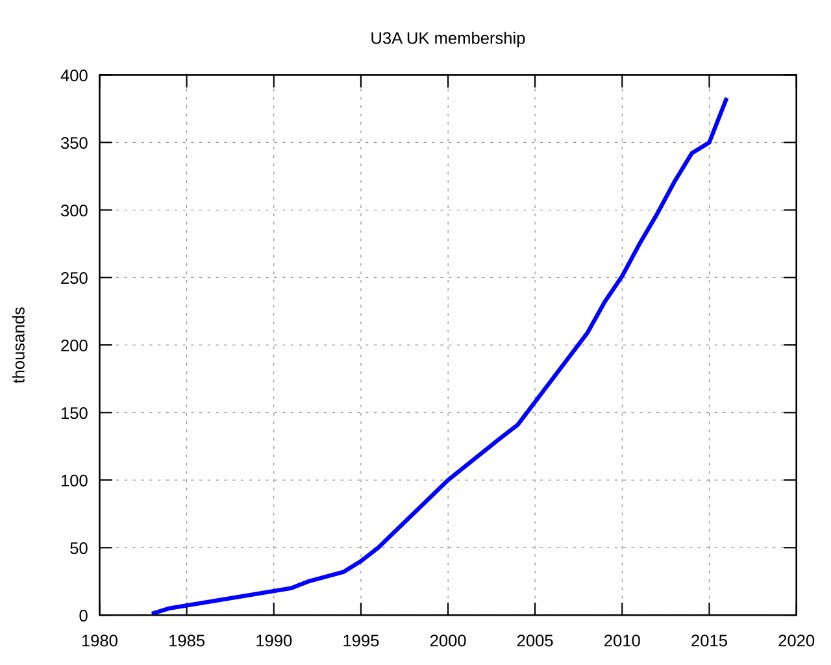
Pre-COVID UK u3a membership numbers
- 2016: The movement celebrated 1,000 U3A branches.
- 2020: The organization rebranded to "u3a" (using lowercase) to ‘modernise’, and place emphasis on collaborative learning rather than traditional academic study.
- 2022: The 40th anniversary was commemorated by the creation of a 'u3a Wood' on the Wales-England border.
In the UK, the movement is supported by a national body, ‘The Third Age Trust’.
For those with a particular interest in the beginnings of u3a, there are a number of sources from which to obtain further information:
https://www.u3a.org.uk/about/the-u3a-story
https://en.wikipedia.org/wiki/University_of_the_Third_Age
Bicester u3a
Bicester u3a - Early Days
The first meeting of the ASTA (Association of Students of the Third Age (Oxon) (Bicester Branch), as it was originally called, was held in July 1986. No written record of the meeting has come to light. That is unfortunate because it has not been possible to discover the circumstances leading to the initial gathering.
The 1st Annual General Meeting (AGM) was held on 15th December 1987. That meeting was chaired by Gp Capt Frank Rice MA FBIM RAF (Rtd). Along with the chairman, the secretary Frank Hinks, the treasurer Eric Dunn and 12 fellow members were present. The membership at that time was 32, and attendance at meetings averaged 15. There had been 43 meetings in the previous 12 months, of which 4 were outside visits. Meetings were being held, more or less, on a weekly basis.
The 2nd AGM was held on 31st January 1989 at Waverley House. The chairman, secretary and 14 members were present. There had been 21 meetings and 6 outside visits in the previous 12 months. The average attendance at meetings was 19. The scrapping of subscriptions, and holding meetings fortnightly, had not been a success. Weekly meetings, and subscriptions had been reinstated in July 1988.
The 3rd AGM was held on 9th January 1990. Officers and 14 members were present. Membership was static at 27. There had been 37 meetings and 3 outings in the previous 12 months. The average attendance at meetings was 16. Annual subscription was £2, plus a fee of 20p for each meeting attended. The Chairman had stressed the need to attract new members. The Treasurer reported that the balance was down £62.41p. It was proposed to raise the fee for attending each meeting to 30p.
The 4th AGM was held on 15th January 1991 at the Bicester Community College. Officers and 16 members were present. There had been 37 meetings and 8 outside visits. The average attendance at meetings was 15. Membership was 24. Low membership was recognised as a serious issue. Several ways to remedy this problem were discussed. The Chairman also raised the question of Special Interest Groups; most other U3A’s had some, whereas Bicester had none at that time. The Treasurer reported that the year-end balance had fallen once again. It was proposed to raise the annual subscription to £5.
The 5th AGM of Bicester U3A was held on 7th January 1992 at the Bicester Community College. Officers and 24 members were present. There had been 43 meetings and 8 outside visits. The average attendance was 19. The membership at the end of the year was approximately 35. The annual subscription was £5.00, with a charge of 30p for each meeting attended. The Treasurer reported that there had been an increase in funds. During 1991, Bicester U3A became a member of the Third Age Trust and adopted their constitution.
The 6th AGM was held on 6th January 1993 at the Bicester Community College. There had been 36 meetings and 8 outside visits. The average attendance was 20. 21 people had attended the Christmas lunch. The Treasurer reported that funds had remained static.
(Although it was not mentioned in the AGM minutes, the first Special Interest Group was actually formed in 1991; that was Needlecraft.)
As a fledgling organisation, it is apparent that Bicester U3A was taking a while to establish itself; great credit is due those officers and members who persisted with its development.
Bicester u3a - Evolution
For an organisation such as Bicester u3a to survive and grow over a 40-year period, there were milestones, events and changes that were important to its evolution. The following itemised list is not exhaustive; however, it does contain a number of the key moments that occurred during that time.
Bicester u3a – Some Notable Events:
- The Bicester Branch of ASTA was formed in July 1986. The inaugural meeting was held in a room at the Methodist Church. 35 people were in attendance. Bicester was the 11th branch to be opened in Oxfordshire, and the 150th in Britain.
- The first AGM of ASTA (Bicester Branch), was held on 15th December 1987.
- The first Special Interest Group (Needlecraft) was formed in 1991.
- Bicester U3A affiliated to the Third Age Trust in 1991, and adopted their constitution.
- There were four Special Interest Groups (SIGs) in 1995.
- Members participated in an ‘Antiques Roadshow’ type event on 2nd April 1996.
- Members visited Stoke Bruerne, the historic canal village on the Grand Union Canal in Northamptonshire, on 16th July 1996.
- A buffet lunch was held to celebrate the 10th anniversary in 1996.
- Bicester U3A Millenium Banner, made by the Needlework Group, was unfurled in 2000. (It depicted the SIGs.)
- Newsletter was started in 2000.
- Number of general meetings reduced to monthly in 2000 (on the 4th Thursday of every month)
- Registered as a Charity [No. 1094759] on 25th November 2002.
- From 2003, funds were deposited with the Charity Bank in order to attract a higher rate of interest.
- 20th Anniversary celebrations took place in 2006. The Bicester Town Mayor and his wife, together with the Hon. Secretary of the Third Age Trust were present. Special Interest Group members participated in a cavalcade to promote their activities.
- Affiliated to Thames Valley U3A in 2008. [ https://u3atvnetwork.org.uk/ ]
- General meetings were moved to the Clifton Centre in Bicester, during 2011.
- 25th Anniversary outing to the Palace of Westminster occurred during Sept 2011. 53 members travelled by coach; they were divided into three groups for tours of the Houses of Parliament; each tour lasted 75 minutes. Afternoon tea on the terrace was served at 4:30PM with the then MP, Tony Baldry. [Maurice Weir liaised with Mr Baldry’s office.]
- A Bicester U3A website was set up in 2011 by Denise Thornton.
- A system for welcoming new members was introduced in 2011; yellow labels and badges were provided to encourage conversations with existing members.
- Bicester U3A Christmas lunch was held at the Littlebury Hotel in December 2011. 48 people participated.
- A Special Interest Group leader’s handbook was produced in 2012.
- Bicester U3A members met in Sheep Street on 9th July 2012 to wave banners and cheer as the Olympic torch passed through Bicester.
- A workshop for Group Leaders/Coordinators was held in High Wycombe on 14th August 2012. It was organised by the South-East Region of U3A to which the Thames Valley Network belongs. (As a result of discussions at the event, an advert for a Group Coordinator appeared in the November 2012 newsletter.)
- Beryl Burn stepped down as Newsletter editor in early 2013, after 11 years in the role.
- 10 Bicester U3A members appeared on ‘Trust Me I am a Doctor’ (BBC2) in 2013.
- The 200th member joined in September 2014.
- On 24th September 2014 a day visit to the National Memorial Arboretum, Staffordshire was arranged for members; 40 members attended.
- A day trip to Salisbury on 23rd September 2015, saw 51 members have a guided tour of the Cathedral, and then visit the Magna Carta exhibition which holds one of only four surviving originals authenticated by King John with the King’s Great Seal in 1215.
- Bicester U3A submitted a Christmas Tree for the St Edburg’s Church display in 2015.
- Members visited the ‘World of Wedgwood’ in Stoke on Trent on 14th April 2016. There was a tour of the factory, followed by a visit to the museum.
- During September 2016, 35 members went on the first 5-day residential holiday trip; they travelled to Northumbria.
- 30th Anniversary celebrations were held on 22nd September 2016. Pam Jones (U3A chairman), and Frank Hinks (founder member), were present. A magician provided the entertainment. A new banner was unveiled; it was crafted by the Arts and Crafts group.
- Beacon (an online management system) for Bicester U3A was set up, and membership data was migrated to it, by Denise Thornton in 2017
- On 29th June 2017, members visited the Viridor Energy Recovery Facility, that opened in May 2015, for a guided tour of the site at the core of which is a large incinerator where non-recyclable waste is turned into energy.
- On 24th May 2018, the UK Government approved the updated Data Protection Act known as Data Protection Act 2018 (DPA 2018). DPA 2018, was a complete rework of the original ‘Data Protection Act’ of 1998. This had implications for the way that all U3As were to be run in the future. For example, it led to the need for an updated Group Leaders Handbook, and there is now a member of the Committee responsible for GDPR.
- On 29th November 2018, members visited Winchester Christmas market, and also had a tour of Winchester Cathedral, where it is possible to see the grave of Jane Austen.
- On 2nd July 2019, members visited Bletchley Park for a tour of the former top-secret establishment where British codebreaking happened during World War II. The intelligence produced had a direct and profound influence on the outcome of the conflict. Members were very impressed and some returned at a later date to complete the full tour for which there had not been enough time.
- During the COVID lockdown in 2020, many groups went online and some meetings were held via Zoom. A weekly Friday evening session was set up as a social event.
- In 2020, the U3A also rebranded to "u3a" (using lowercase) to ‘modernise’, and place emphasis on collaborative learning rather than traditional academic study.
- The Third Age Trust, in collaboration with the Charity Commission, established a standardized Model Constitution in 2021. This model mandates rules regarding charitable objects, trustee tenure, governance procedures, and voting processes to ensure compliance with UK charity law. Because individual u3a’s operate as independent, registered charities, any structural constitution changes must align with this national framework.
- The 35th AGM was held on 27th Jan 2022 via Zoom.
- ‘Picnic in the ‘Park’ was held at Chesterton Community Centre on the 1st June 2022 to celebrate the national u3a’s 40th anniversary. Bicester u3a had reached its 35-year anniversary in 2021 but members were unable to celebrate due to the COVID pandemic; so, this event celebrated both milestones.
- 38 members visited Portsmouth’s Historic Dockyard on 21st July 2022 for a harbour tour and visits to the many attractions on offer, including the new Mary Rose exhibition, HMS Victory and HMS Warrior. There was not enough time to visit everything and tough decisions had to be made.
- 57 members visited Bath Christmas market on 1st December 2022. Some people spent the day at the other attractions Bath has to offer, including the Pump Room, the Baths, and various museums.
- A residential holiday for members to the Lake District, began on 12th June 2023. They stayed at a hotel near to Lake Windermere, and enjoyed visits to Dove Cottage, the Ruskin Museum, Ravenglass, and the Eskdale narrow-gauge steam railway that travels from the coast at Ravenglass up into the scenic Eskdale Valley, leading to the foothills of Scafell Pike (the highest mountain in England).
- A new Bicester u3a group leader’s Handbook, explaining the required steps for setting up and running a group, was produced in 2023 by Jan Laker.
- There was a day-trip to Batsford Arboretum during April 2024.
- On 16th June 2024, 32 members went away on the ‘annual’ residential holiday; this year to Northumberland. They stayed at the Caledonian Hotel, near to Newcastle. Visits included, Bamburgh Castle, Lindisfarne, the Beamish Living Museum, Cragside country house, Durham Cathedral, Alnwick Castle and Nostell Prior, near Wakefield.
- In 2024 the u3a Trust's Siteworks Team developed a custom version of the WordPress website platform for use by its members because the old platform was no longer fit for purpose. Tomy Duby, aided by Krys Kazmierczak, spent a few months transferring the material from the old website to this new platform while enhancing the material with many new photographs.
- The Constitution of Bicester u3a, an unincorporated members’ association, and a member of the Third Age Trust, was adopted on 25th January 2025.
- 43 members went on a day trip to Bournemouth during June 2025.
- From 1st to 7th July 2025, 44 members visited Plymouth, Devon; they stayed at the Duke of Cornwall Hotel. During the stay members visited, Agatha Christie’s holiday home at Dartmouth, the Eden Project, Pencarrow House & Garden, Bodmin Jail, the Lost Gardens of Heligan, and Mevagissey.
- 40th Anniversary celebrations got underway in January 2026 when a Groups Showcase Event was held at the Methodist Church Hall in Bicester. The hall was packed with members and visitors. Those who attended said that everyone was really friendly and how much they’d enjoyed it. “Buzzing” was how many people described the atmosphere. The event gave those who attended a chance to find out what other groups do, and to socialise with members they don’t often see. There were games of table tennis, Mah Jong and Rummikub, while the Ukulele Group played. There were paintings, crafts, stitch craft, and much more on display. Nearly all activities were represented. It was deemed a great success - 13 visitors signed up for membership and several others took membership forms away.
- On Tuesday 30th June 2026, there was a Hog Roast to celebrate the 40th anniversary at The Littlebury Hotel, Bicester. In fine weather there was entertainment, multiple activities and good food, with 120 members dancing, playing games, chatting and generally enjoying the day. The entertainment was provided by our u3a’s lively rock group, The Grim Reapers, whose performance had many members singing along; and also, members of the Ukulele Group who played before an excellent lunch was served. Gerald Hodges was overall winner of the Games. Alison Crutchfield won the Treasure Trail and Eileen Dennett won the cake decorating competition.
The Bicester Branch of ASTA that was formed in 1986, was significantly different from Bicester u3a in 2026. They were, however, similar in one very important way: their aim to serve the social needs of older people, to assist those people in maintaining meaningful connections, provide a sense of purpose, and encourage community involvement for the good of their health and well-being.
Bicester u3a membership numbers
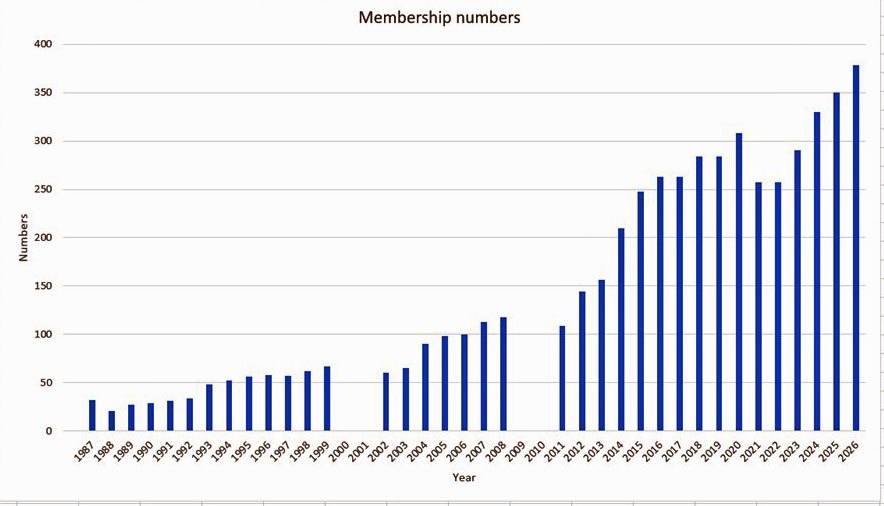
It is apparent that membership numbers were comparatively low in the beginning and that it took a while for numbers to rise significantly. It was not until 2006 that numbers passed 100. Then they began to increase more rapidly and they have grown steadily ever since, with just one reversal which occurred during the COVID pandemic. The following vertical bar chart shows how Bicester u3a membership numbers have varied with time. [The gaps are those years for which no data is currently available.]
Bicester u3a Special Interest Groups
- At the time of the 4th AGM in January 1991, there were no Special Interest Groups within Bicester U3A. (Bicester was unusual in this regard.)
- 1991 saw the setting up of the first SIG, when the Needlecraft Group was formed.
- By 1996, there were four SIGs: Bridge, Needlecraft, Play Reading, and Walking.
- In 1997 it was reported that the Walking Group was struggling but that there were three new Groups; Sunday lunch, Painting, and German conversation.
- In 2000, the Needlecraft Group produced a Millenium Banner that was unfurled at the AGM of that year.
The following graph shows how the number of Special Interest Groups has varied with time. The data points are at the AGM each year. [The gaps are for those years where no data is currently available.]
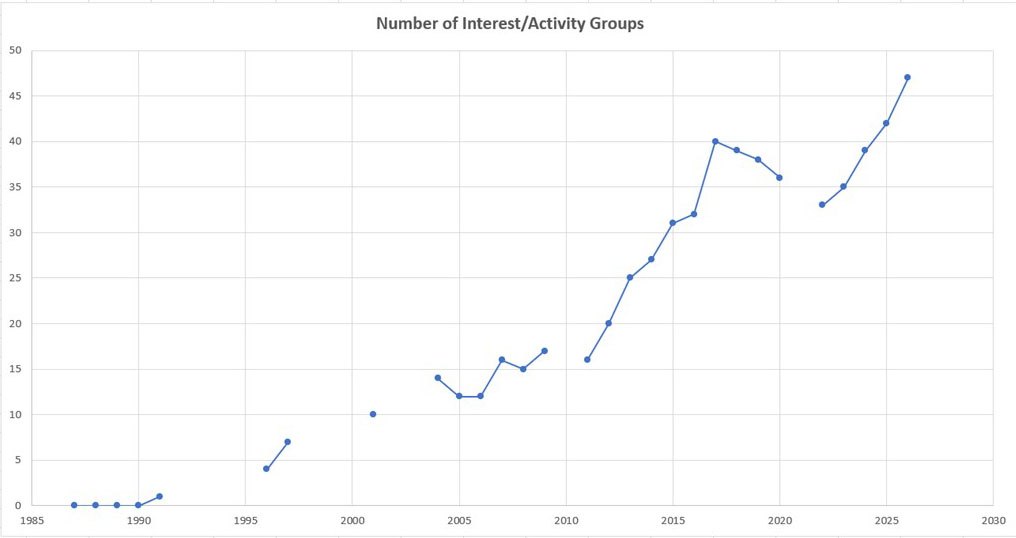
From those two graphs it is possible to see a correlation between membership numbers and the number of Special Interest Groups. In a way this is a "chicken and egg" situation in that it is not really possible to know which, if either, of those two interdependent numbers drove the other. I suspect that without SIGs, membership numbers would not have grown to the extent that they have.
Special Interest Group activities within Bicester u3a are not particularly well documented, although reports in the Bicester u3a Newsletters give some indication of what has occurred in a number of the groups. A notable exception is the ‘Garden Visits Group’ for which details of visits and photographs are available from 2009 onwards.
Bicester u3a Officers
The key roles of Chair, Treasurer, and Secretary, are essential to the running of an organisation such as Bicester u3a. Without people who are prepared to take on those roles, Bicester u3a could not exist.
25 individuals have filled the roles of Chair, Treasurer and Secretary of Bicester u3a since it was formed, 40 years ago. Those people are:
Kathleen Burgess, Christine Cox, Valerie Day, Eric Dunne, Joan Fuller, Andy Gordon, Mary Herbert, Frank Hinks, Geoff Iredale, David Jones, Anthony Lock, Audrey Luff, Sheila Maclean, Norah Morgan, Nick Morse, Peggy Penfold, Garth Perkins, Frank Rice, Jim Rousell, Doreen Shirley, Sandie Stevenson, Ray Thomas, David Thornton, Joyce Tidmarsh, Ian White
A year-by-year list can be seen here.
To those 25 people, the membership (past and present), owes a huge debt of gratitude; because without them there would be no Bicester u3a.
There are, of course, plenty of others who have contributed significantly to the smooth running of the organisation; not the least being those people who have given their time to serve on the Committees over the years. Some people have already been named in the list of notable events. To the others, I apologize for their omission.
Concluding thoughts
This document is primarily designed to give some indication of Bicester u3a’s past. For details of what is currently going on, there is no better place to start than by looking at the website: https://bicester.u3asite.uk/
An organisation like Bicester u3a is totally dependent on the contributions of its members for its survival. It has no external funding, and all activities are run by members who are willing to give freely of their time and effort. It is to be hoped that such contributions continue.
The upward trajectory of the membership numbers is a good indication that Bicester u3a is meeting a need within its catchment community. Likewise, the number and variety of Special Interest Groups, a number of which have waiting lists.
Copies of Bicester u3a AGM minutes, and most newsletters, do exist in paper form; their survival has been important in helping to put this document together. A number of those documents require careful handling and on some the text is beginning to fade. It is to be hoped that these can be archived electronically in the near future.
Acknowledgements
The following people have helped by generously providing me with their memories, photographs, old newsletters and AGM minutes; without those I would not have been able to prepare this document: Christine Cox; Valerie Day; Sylvia Frydland; Dave Jones; Jan Laker; Peggy Penfold; Di Roberts; Christine Tulloch; David Thornton; Denise Thornton.
Also, Krys Kazmierczak for careful proofreading of this document.
To them I extend my sincere gratitude.
Charles L Wrench - September 2026